July 18, 2014: Tales of Interest July 19, 2014
Posted by tomflesher in Baseball.Tags: Mets, Tales of Interest
add a comment
- Kirk Nieuwenhuis has a .580 slugging average. Let me put that into slightly different terms for you. When Kirk walks up to the plate, assuming he doesn’t walk, he’s averaged over HALF A BASE. ASSUMING HE DOESN’T WALK. And that’s including his rough start! In 37 plate appearances since returning from Las Vegas, he’s at .656.
- Another day, another intentional walk for Ruben Tejada. Ruben’s OBP is .358, and in the 8th position (usually with the pitcher behind him) it jumps to a filthy .375. Yeah, it’s a bit inflated, but even if you removed his ten intentional walks from the season entirely, you still end up with 92 times on base and 287 plate appearances for a .320 OBP. The median OBP for qualified shortstops is .317; I never would have guessed Tejada for an above-average batter. Yeah, yeah, he’s got the pitcher behind him. He’s also costing us less than $4,000 per plate appearance (and falling).
- Bobby Abreu‘s OBP, meanwhile, is .377. I’m so glad we have a credible threat off the bench. The man’s even got a bunch of doubles, which would be triples if Kirk were hitting them.
- Lucas Duda (.482), Curtis Granderson (.422), David Wright (.416) and Daniel Murphy (.408) are qualified and have SLG above .400. On the other hand, since coming back from the disabled list, Juan Lagares hasn’t walked at all in 63 plate appearances. Last night, Juan was 1 for 4 with 2 RBIs.
- Since moving to relief, Jenrry Mejia has a 2.25 ERA, including his two blown saves. That’s 2.95 in save situations, but 0.69 in successfully converted saves. When it rains, it pours.
Oh, Madison, You’ll Make Fools Of Us All July 14, 2014
Posted by tomflesher in Baseball.Tags: Jacob deGrom, Madison Bumgarner, Pitchers batting
1 comment so far
Just the other day, I said that pitchers don’t reliably hit well enough to consistently earn themselves cheap wins, and then Madison Bumgarner goes and hits a go-ahead (and game-winning) grand slam. Jacob deGrom hit an RBI of his own, but it was as part of a 9-1 Mets rout of the Marlins. Bumgarner actually earned his win (a cheap one, at that) by hitting the go-ahead RBI. Sickeningly, he did the same thing back in April.
Interestingly, Travis Wood is another pitcher who has twice this year had at least as many RBIs as the margin of victory for his team – once in April, once in May, and once in June – although in one case the save was blown. Dan Haren and Edinson Volquez each have two games as well, although Volquez only nabbed one win. A handful of other pitchers have at least one RBI in one-run games as well.
So, Madison, mea culpa. I’m sorry I ever doubted you.
Quality Starts and Differential Luck July 12, 2014
Posted by tomflesher in Baseball, Economics.Tags: quality starts, Zack Wheeler
add a comment
 On July 11, Zack Wheeler gave the Mets a quality start by either definition – he pitched 6 2/3 innings and allowed only one run for a game score of 64. The Mets managed to convert it into a win, which they’ve managed to do in 27 of their 46 wins thus far this year. Zack’s made 12 quality starts this year (by the sabermetric definition of a game score of 50 or more), but the Mets have managed to convert only 5 of them into Ws for Zack; the team is 7-5 in those games, while Zack himself is 5-2. That’s a far cry from the Giants’ freakish Tim Lincecum (9-0 in 12 quality starts) and the Angels’ Garrett Richards (10-0 in 15 quality starts). (The whole list of pitchers with quality starts so far is here.)
That got me thinking – which teams do the best at converting quality starts into wins? Which teams are the worst? What’s the relationship? I grabbed all of these numbers and put them together into a spreadsheet in order to play with them.
First, a quick review of terms: A cheap win is a pitcher win in a non-quality start. A tough loss is a pitcher loss in a quality start. “Luck” is whatever I happen to be measuring at the moment, but today ‘luck differential’ refers to the difference between the percentage of wins that are cheap and the percentage of losses that are tough; in other words, luck differential = 100*[(CW/W) – (TL/L)]. For an individual pitcher, these are fairly random occurrences – no pitcher in MLB today hits reliably enough to consistently earn himself cheap wins – but it seems that aggregating by team allows for the quality of batting to smooth out over a large number of games.
The Texas Rangers lead the league in this sort of luck differential, with 4 of their 38 wins coming cheaply for over 10% cheap wins but only 2 of their 55 losses tough (3.64); the Atlanta Braves have the worst luck differential in the league with a high proportion of tough losses (17/42, or 39.53%) and a low number of cheap wins (3/50, or 6%) for a total of -33.53. The Mets themselves convert less than 50% of their quality starts into wins for the starting pitcher.
These numbers are indicative of a general trend. The more quality starts a team has, the more negative its luck differential is (ρ = -.72 – an extremely strong correlation) and the more wins a team has, the more negative its luck differential is (ρ = -.20 – a bit weaker). Essentially, teams with more quality starts generate more wins (ρ = .56), regardless of the fact that sometimes they lose those quality starts, too. Surprisingly, the Mets have a -21.67 luck differential, one of the most negative in the league, probably due to the fact that they convert so few quality starts into wins.
Bartolo Colon Needs a Three-Hour Warmup July 11, 2014
Posted by tomflesher in Baseball.Tags: Bartolo Colon, Stuff Gary Cohen Says
add a comment
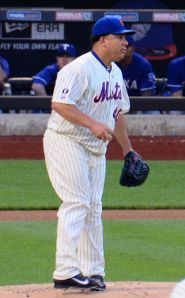 Mets veteran starting pitcher Bartolo Colon had a very familiar outcome last night: He allowed three earned runs in the first inning, followed by seven innings of scoreless ball. He took the loss to Aaron Harang, 3-1. Harang pitched an excellent game and Craig Kimbrel was lights-out, as he often is. It was a quality start by any definition, making it Colon’s third tough loss. Though Bart hasn’t picked up any cheap wins this year, 11 of his 18 starts have had game scores of 50+, and 12 of them have been “headline” quality starts of 6+ innings with 3 or fewer runs. 8 of them have been “super quality starts,” per Gary Cohen, of 7+ innings with two or fewer runs; he’s won all of those.
There’s an endogeneity problem in stating that Colon gets better when he’s allowed to pitch longer, since obviously his better pitching is the cause, not the effect, of going 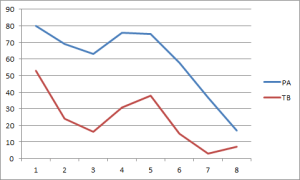 longer into the game. Nonetheless, Colon demonstrates a strong pattern of underperformance in the first inning. His ERA is a striking 8.47 in the first inning and literally half that – 4.24 – in the second (stats NOT INCLUDING last night’s game). Colon’s best inning is the third, but he’s serviceable through the remaining innings as well. His first inning involves facing the most batters, as indicated by the huge spike in total bases; he just has trouble getting opposing batters out during the first. He’s structurally different, too: he gives up nearly 3/4 of a base per plate appearance in the first, and every first-inning plate appearance is worth one-fifth of a run. Part of this tracks with Colon’s shifting BAbip, which spikes along with his per-plate-appearance stats – it looks almost exactly like the graph of total bases per plate appearance – but you can’t blame defense for numbers like this.
 There’s not much explanation for this. It’s the sort of pattern you’d expect from an inexperienced pitcher who doesn’t warm up properly. He didn’t have the same problem last year or the prior year, when his first-inning ERA was reliably 3.00. This is difficult to pinpoint, but maybe Colon should take some advice from Daisuke Matsuzaka and do a three-hour warmup.
Quickie: Farnsworth is unraveling June 13, 2014
Posted by tomflesher in Baseball.Tags: Kyle Farnsworth
add a comment
While the World’s Worst Sports Blog is on a temporary work-related hiatus, its regular entries have been replaced with periodic unfocused ranting by the author.
When the Mets released Kyle Farnsworth, I celebrated. Although he’d converted 3 out of 4 save opportunities, he was a waste of money for an unpredictable arm. He’s been wildly inconsistent throughout his career and wasn’t worth the money the Mets had decided to spend on him.
It’s clear why he was given the chance to close: in his first ten games, Kyle has a 0.96 ERA and a 6/2 KBB on a BAbip of .286. His next nine games before release tell a different story: he threw a 5.86 ERA, and yes, some of that is due to his BAbip jumping to .320. It was also due in part to his inability to throw strikes; he faced 36 batters on 138 pitches in the first ten games, 65% of them strikes; in his second block of games, he faced 35 batters on 137 pitches (almost identical) but his strike percentage dropped to 58% and his KBB fell to 4/4. (That basically means he took two Ks and replaced them with walks. Good for you, Kyle!)
Thus far, his time with the Astros has been mostly new Kyle, not old Kyle: 11 games, .280 BAbip, 58% strikes, and a KBB below 1. Thanks, Houston, for taking him off our hands!
Temporary Hiatus June 4, 2014
Posted by tomflesher in Baseball.add a comment
The World’s Worst Sports Blog is temporarily on hiatus while its maintainer works a ton of overtime teaching Kaplan’s MCAT Summer Intensive Program in Boulder, Colorado. Regular1 updates will resume on July 1.
Said maintainer may be contacted on Twitter at @tomflesher and looks forward to attending a Rockies-Dodgers game this weekend, where with any luck he will see Chone Figgins pinch-walk.
—–
1 Not a guarantee.
Chone Figgins is below the Mendoza line, so why has he earned his spot? May 7, 2014
Posted by tomflesher in Baseball.Tags: Baseball, Chone Figgins, Dodgers
add a comment
It’s no secret to regular readers, if any, that I’m a fan of Chone Figgins. The Dodgers picked him up as a free agent and kept him on the roster this year. He’s hitting abysmally – in 15 plate appearances, he’s mustered only a single hit, and that was way back on April 12th – and at age 36 he isn’t getting any younger. Nevertheless, I think he’s earned his spot.
First, the Dodgers knew what they were getting. The last time Figgins hit above the Mendoza Line (.200) was 2010, and he sat out 2013 entirely. No one brought him on expecting him to be an everyday player with a high batting average. What they had a right to expect was a player who reliably walks 10% of the time – well above the league average of 7.7% – and who won’t strike out very often1. Thus far, Figgins has given them exactly that.
Although he has only hit once in his 15 plate appearances, he’s walked 5 times, with those walks spread out fairly evenly throughout the season. Those walks give him a tiny slugging percentage but an enormous OBP – hitting one out of every 15 isn’t bad if you’re walking five more, yielding an OBP of .400 (even with a SLG of .100). Figgins is low-variance – you can put him in to pinch-hit knowing that he’ll regularly walk. He may never hit a home run (and he hasn’t since April of 2012), but he’ll definitely walk regularly. (This is probably due to his being 5’8″ and it being impossible to locate a pitch in his strike zone.)
I have no delusions that Figgins is going to continue to walk 1 out of every 3 times he comes to the plate, but I also don’t think he’ll continue hitting quite so badly. He may not stay at .400 OBP all year, but he also won’t stay at a .100 batting average.
Just for fun, I dug up some other players who had seasons below .200 BA and above .375 OBP. Matt Stairs is the king here, getting 129 plate appearances in 99 games for Philadelphia in 2009. Tyler Flowers got around my “no pitchers and no catchers” restriction in 2009 by appearing in more than 50% of his games DH or PH. Otherwise, it would be easy to find catchers who are kept on the roster not for their hitting but for their defense, and since light-hitting catchers hit 8th, they’ll earn a lot of walks just based on position in the batting order.
| Rk | Player | Year | PA | Age | Tm | Lg | G | AB | BB | SO | Pos | |||
|---|---|---|---|---|---|---|---|---|---|---|---|---|---|---|
| 1 | Chone Figgins | 2014 | .400 | .100 | 15 | 36 | LAD | NL | 13 | 10 | 5 | 3 | .500 | *H/75 |
| 2 | Nick Johnson | 2010 | .388 | .167 | 98 | 31 | NYY | AL | 24 | 72 | 24 | 23 | .693 | *D/H3 |
| 3 | Tyler Flowers | 2009 | .350 | .188 | 20 | 23 | CHW | AL | 10 | 16 | 3 | 8 | .600 | /*2HD |
| 4 | Matt Stairs | 2009 | .357 | .194 | 129 | 41 | PHI | NL | 99 | 103 | 23 | 30 | .735 | *H/97D |
| 5 | Dallas McPherson | 2008 | .400 | .182 | 15 | 27 | FLA | NL | 11 | 11 | 4 | 5 | .764 | /*H5 |
| 6 | J.J. Furmaniak | 2007 | .364 | .176 | 22 | 27 | OAK | AL | 16 | 17 | 3 | 8 | .599 | /HD46957 |
| 7 | Michael Tucker | 2006 | .378 | .196 | 74 | 35 | NYM | NL | 35 | 56 | 16 | 14 | .700 | H7/93 |
| 8 | Brian Myrow | 2005 | .360 | .200 | 25 | 28 | LAD | NL | 19 | 20 | 5 | 8 | .610 | *H/3 |
—–
1Probably due to being 5’8″ and it being impossible to locate a pitch in his strike zone.
The Giants are nothing if not consistent. May 6, 2014
Posted by tomflesher in Baseball.Tags: Giants, weird lines
add a comment
May 5, 2014: Giants 11, Pirates 10, in 13 innings. Wining pitcher: Jean Machi. Save: Sergio Romo.
April 23, 2014: Giants 12, Rockies 10, in 11 innings. Winning pitcher: Jean Machi. Game finished: Sergio Romo.
Have I made a “roll the Daisuke” pun yet? I haven’t? Good. May 6, 2014
Posted by tomflesher in Baseball.Tags: Daisuke Matsuzaka, Mets
add a comment
I like what Terry Collins is doing with Daisuke Matsuzaka. I know Daisuke had never pitched in relief in his career, but Terry broke him in with a couple of clean-inning appearances that probably felt a lot like starting a game. Matsuzaka was also useful as long-relief in one of the extra-innings games and in providing a solid backup plan for Zach Wheeler and Jenrry Mejia in case they get wild, and for Bartolo Colon‘s back.
Daisuke had a rough game last night, coming in to relieve Jon Niese in the eighth to set up the Mets’ *sigh* closer, Kyle Farnsworth. In 10.1 innings pitched, Matsuzaka had allowed 2 runs on 4 hits and 6 walks, striking out 13 for an ERA of 1.74 on an average 1.3 days rest. On one day’s rest, Daisuke opened the inning with two walks and a single, followed by a crushing error by Omar Quintanilla that kept Casey McGehee alive. Granted, the game looks different if McGehee was out, and Terry probably wouldn’t have been as quick to hook him and put in Kyle Farnsworth. Still, in a game that was tied going into the 9th, it’s hard not to look at that unearned run as a game-changer. Mastuzaka left with three runs, two earned, and no outs; his ERA doubled, spiking to 3.48.
Matsuzaka isn’t the only pitcher in that position this year; in April, Nate Jones of the White Sox appeared in two consecutive games and faced a total of five batters. He failed to make any outs, walking three and allowing two hits. Each day, he was responsible for two earned runs. Though Jones is no longer with the White Sox, his zero innings pitched and four earned runs give him the theoretical infinite ERA (4/0; remember your baby calculus class? 4/x has a limit of infinity as x approaches 0). Jones had back surgery yesterday and will be off the mound for the foreseeable future.
On the other end of the scale, Shawn Tolleson appeared as a Dodger only once in 2013, walking two batters – neither of whom scored – before going out for back surgery that shut him down for the season. Since neither batter scored, Tolleson’s ERA is undefined, as a 0/0. Tolleson’s having a much more normal season as a Ranger this year.

 The World's Worst Sports Blog