Home Runs Per Game: A bit more in-depth December 23, 2011
Posted by tomflesher in Baseball, Economics.Tags: AR, autoregression, baseball-reference.com, home runs, home runs per plate appearance, linear regression, talent pool dilution
add a comment
I know I’ve done this one before, but in my defense, it was a really bad model.
I made some odd choices in modeling run production in that post. The first big questionable choice was to detrend according to raw time. That might make sense starting with a brand-new league, where we’d expect players to be of low quality and asymptotically approach a true level of production – a quadratic trend would be an acceptable model of dynamics in that case. That’s not a sensible way to model the major leagues, though; even though there’s a case to be made that players being in better physical condition will lead to better production, there’s no theoretical reason to believe that home run production will grow year over year.
So, let’s cut to the chase: I’m trying to capture a few different effects, and so I want to start by running a linear regression of home runs on a couple of controlling factors. Things I want to capture in the model:
- The DH. This should have a positive effect on home runs per game.
- Talent pool dilution. There are competing effects – more batters should mean that the best batters are getting fewer plate appearances, as a percentage of the total, but at the same time, more pitchers should mean that the best pitchers are facing fewer batters as a percentage of the total. I’m including three variables: one for the number of batters and one for the number of pitchers, to capture those effects individually, and one for the number of teams in the league. (All those variables are in natural logarithm form, so the interpretation will be that a 1% change in the number of batters, pitchers, or teams will have an effect on home runs.) The batting effect should be negative (more batters lead to fewer home runs); the pitching effect should be positive (more pitchers mean worse pitchers, leading to more home runs); the team effect could go either way, depending on the relative strengths of the effects.
- Trends in strategy and technology. I can’t theoretically justify a pure time trend, but I also can’t leave out trends entirely. Training has improved. Different training regimens become popular or fade away, and some strategies are much different than in previous years. I’ll use an autoregressive process to model these.
My dependent variable is going to be home runs per plate appearance. I chose HR/PA for two reasons:
- I’m using Baseball Reference’s AL and NL Batting Encyclopedias, which give per-game averages; HR per game/PA per game will wash out the per-game adjustments.
- League HR/PA should show talent pool dilution as noted above – the best hitters get the same plate appearances but their plate appearances will make up a smaller proportion of the total. I’m using the period from 1955 to 2010.
After dividing home runs per game by plate appearances per game, I used R to estimate an autoregressive model of home runs per plate appearance. That measures whether a year with lots of home runs is followed by a year with lots of home runs, whether it’s the reverse, or whether there’s no real connection between two consecutive years. My model took the last three years into account:

Since the model doesn’t fit perfectly, there will be an “error” term, 

The results:

The DH and batter effects aren’t statistically different from zero, surprisingly; the pitching effect and the team effect are both significant at the 95% level. Interestingly, the team effect and the pitching effect have opposite signs, meaning that there’s some factor in increasing the number of teams that doesn’t relate purely to pitching or batting talent pool dilution.
For the record, fitted values of innovations correlate fairly highly with HR/PA: the correlation is about .70, despite a pretty pathetic R-squared of .08.
Quickie: R.A. Dickey Does It Again September 13, 2011
Posted by tomflesher in Baseball.Tags: Cheap Wins, Dickey gets the shaft, Hiroki Kuroda, Jeremy Hellickson, Mike Nickeas, Quality No-Decisions, quality starts, R.A. Dickey, Tough Losses
add a comment
Last night’s Mets game offered a familiar situation: R.A. Dickey started the game and pitched seven strong innings. He allowed only three runs. He was also the losing pitcher.
By any measure, his 7 innings, 3 runs (2 earned), no walks and 7 strikeouts were a quality start. (They gave him a game score of 58, and matched the 6-inning, 3-run criterion MLB uses for a quality start.) Three innings was enough, though, to give the Mets the loss. The Mets have given up an average of 4.57 runs per game this season, putting them .39 above the NL average and 13th in the league. That’s not too bad – except that they only score 4.44, and that extra 13% of a run adds up over time. (Note that when I crunched numbers for home field advantage, the Mets’ home advantage was quite high, at 1.4 more runs scored at home, so last night’s performance was quite a letdown.) The Mets weren’t running a September callup lineup, either – Mike Nickeas was at catcher, but the rest of the lineup was pretty consistent.
Dickey’s had a rough year. A loss in a quality start is called a Tough Loss, and he’s had six of them. That doesn’t lead the league – Hiroki Kuroda and Jeremy Hellickson split that honor with eight each – but it’s tough to pin all of the blame on Dickey when he’s pitched to six tough losses. Worse, he has seven Quality No-Decisions, which are, predictably, no-decisions in quality starts. Those are more common, but it means that of Dickey’s 30 starts, with 19 of them quality starts, a whopping 13 of them haven’t gotten him a win. By contrast, of his 8 wins, only 2 came in non-quality starts. (We call those Cheap Wins.) That kind of breakdown shows a lack of support from the team.
It’s not like the Mets are this unsupportive all the time, though – Dickey’s six Tough Losses were over one-third of the 17 Tough Losses earned by the team this year, and his seven Quality No-Decisions are around one-third of the Mets’ 22 quality starts with no-decisions for the pitcher. His two Cheap Wins? The Mets have sixteen.
Dickey just can’t get lucky this year.
Who’s Next: The Last 600-Home-Run Post For A While August 25, 2011
Posted by tomflesher in Baseball.2 comments
Jim Thome managed to crack the 600-home-run mark on August 12, hitting #599 and #600 in consecutive plate appearances. Since he was hitting home runs at a rate of .044 per plate appearance, his choke index – which is (1 – the likelihood of not hitting a home run) raised to the power of the number of plate appearances, is undefined. Since he went 0 plate appearances without a home run, it should be 1, but he can hardly be said to have choked.
But I digress.
A lot of people have been finding The World’s Worst Sports Blog by searching for “who’s next to 600 home runs”, which usually brings up this old post of mine. Of course, since it determines that Thome is next, it’s not terribly useful. The leaderboard for home runs (active players only) gives us Manny Ramirez, who retired early in the season, as following Thome up with 555. Chipper Jones follows with 448, followed by Vladimir Guerrero with 446, Albert Pujols with 439, Jason Giambi with 427, and Andruw Jones rounding out the top 5 with 416. Suffice to say it’ll be a while before anyone hits #500, much less #600. (No one else is above 400.)
The ages of the players involved – Chipper is 39, Giambi is 40, Guerrero is 36, Andruw is 34, and Pujols is a sprightly 31 – make things a little more interesting. Let’s take a look at them one by one:
- Chipper Jones, age 39, 448 home runs. His production was about .03 home runs per plate appearance in 2009 and 2011, but dropped to about .026 in 2010. If he has 52 home runs to hit, and he only hits a home run about 3% of the time, it’ll take about 1733 plate appearances to hit #500, and about triple that to hit #600. 1733 plate appearances is about three years of full-time play (600 plate appearances over three years would be 1800), and I can’t imagine Chipper maintaining his hitting ability with his history of injuries. He may stick around until he’s 42 to hit #500, but he won’t hit #600.
- Vladimir Guerrero, age 36, 446 home runs. Vlady’s a high-variance hitter. His home run production over the past few years has been .041, .045, .037, .045, and then .022 this year. Let’s downgrade him to about .04 to account for age. That gives him 135 plate appearances to #500 and about 385 to #600. If he normalizes down to about .03, his numbers will be similar to Jones’. For Vlad, consistency is going to be the biggest hurdle to making a milestone.
- Albert Pujols, age 31, 439 home runs. Albert is hitting at a career low .027 clip this year. His previous years were .047, .057, .067, .06, and this year he’s way down at .027. That’s probably due to his fractured wrist, so let’s credit him with .05 home runs per plate appearance over the next few years. That means he’ll take about 1220 plate appearances to #500, or about 3220 to #600. He’ll need to play to the ripe old age of 36 to hit his 600th home run, so I think he’s a pretty safe bet.
- Jason Giambi, age 40, 427 home runs. Giambi has hit at a .09 rate this season, but as he’s a full-time pinch hitter, he’s only made 122 plate appearances. Even assuming he hits at a .05 home run per plate appearance rate, and assuming he played a full season of 600 plate appearances as a DH, he’d need almost two and a half seasons (1460 plate appearances) to make his 500th home run. That would make him over 42. He won’t make it that far.
- Andruw Jones, age 34, 416 home runs. Jones’ production has consistent – in 2009 he hit .051 home runs per plate appearance, and this year and last have both been around .058. Let’s call his average production going forward .055. He’ll need about 1527 plate appearances before he hits his 500th, or about 3345 before #600. Those normalize to about two and a half years and about five and a half years, respectively. Of course, Jones hasn’t made 600 plate appearances in a while – he’s made about 300 for the past few years. Still, doubling the time to hit 500 and 600 still put #500 within striking distance for Jones, who would be about 39 five years from now.
Realistically, Albert Pujols is the only one of this group who’s likely to make 600 home runs at all, much less within a few years.
Bobby Bonilla, Financial Genius? August 1, 2011
Posted by tomflesher in Baseball, Economics.Tags: annuity, Bobby Bonilla, compound interest, deferred compensation, finance, Mets
5 comments
When Bobby Bonilla signed a deferred compensation agreement in 2000, the Mets owed him $5.9 million dollars. Basically, the Mets got to hold on to the $6 million or so (and ended up spending it on payroll), but they had to pay Bonilla back a bit more in interest. His yearly payments are $1,193,248.20, which means that in absolute terms, the Mets are paying him $35,797,446 in total over the next 25 years. Of course, the $1.19 million Bonilla gets today is worth much more than the same-size payment he’ll get in 2036.
Bonilla’s arrangement mimics a financial instrument called an annuity, where a constant payment is made at specific time periods after a specific present sum is invested. The annuity formula is:
![Present Value =Payment \times [\frac{1 - \frac{1}{(1 + r)^t}}{r}]](https://s0.wp.com/latex.php?latex=Present+Value+%3DPayment+%5Ctimes+%5B%5Cfrac%7B1+-+%5Cfrac%7B1%7D%7B%281+%2B+r%29%5Et%7D%7D%7Br%7D%5D&bg=ffffff&fg=666666&s=0&c=20201002)
where r is the annualized interest rate and t is the number of years of payment. Keep in mind, though, that the present value of the annuity isn’t $5.9 million – it’s $5.9 million compounded annually at some rate of interest agreed to by Bonilla and the team for the ten years between the deal and the first payout. In general, that means
![5900000\times(1 + r)^{10} = Payment \times [\frac{1 - \frac{1}{(1 + r)^t}}{r}]](https://s0.wp.com/latex.php?latex=5900000%5Ctimes%281+%2B+r%29%5E%7B10%7D+%3D+Payment+%5Ctimes+%5B%5Cfrac%7B1+-+%5Cfrac%7B1%7D%7B%281+%2B+r%29%5Et%7D%7D%7Br%7D%5D&bg=ffffff&fg=666666&s=0&c=20201002)
Since we know Bonilla’s payout, we can substitute in:
![5900000\times(1 + r)^{10} = 1193248.2 \times [\frac{1 - \frac{1}{(1 + r)^t}}{r}]](https://s0.wp.com/latex.php?latex=5900000%5Ctimes%281+%2B+r%29%5E%7B10%7D+%3D+1193248.2+%5Ctimes+%5B%5Cfrac%7B1+-+%5Cfrac%7B1%7D%7B%281+%2B+r%29%5Et%7D%7D%7Br%7D%5D&bg=ffffff&fg=666666&s=0&c=20201002)
and that solves out neatly to the 8% that the team and Bonilla agreed to. The math checks out so far.
At the time the deal was made, the 8% was 50 basis points (0.5%) below the Prime Rate, the reference rate used by banks in making loans. The average prime rate over the previous year was about 8.16%, and rates had hovered within 75 basis points since September of 1994*, so while interest rates are expected to move, it was very likely that rates would stay similar, at least in the short term. For the record, a 30-year fixed rate mortgage would have cost between 8.15% and 8.25%, so taking into account the long maturity of the loan, it wasn’t a bad deal.
Let’s look at how good a prediction it was. Annualizing prime rates, the Mets could have earned a (full prime) rate of return as follows:

So, the actual value of the $5.9 million on January 1, 2011, was $10,891,903.26, but the agreement pegged the value at

for a difference of about $1.85 million. Bobby’s already better off because historical interest rates didn’t keep up with 8%.
My biggest question is why the Mets agreed to an 8% interest rate then and there to be in effect for the next 35 years. Since I’m not a finance professional, I don’t know whether that’s an industry standard agreement or not, but it seems like the risk of setting an interest rate that far in the future would be far too high. What if the Mets had agreed to the 8% interest rate for ten years and then offered Bonilla a menu of financially equivalent options? All of them would rely on the payment formula:
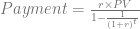
where t is the number of periods and r is the newly figured interest rate.
One option would be to take the $12,737,657.48 as a lump sum, although that wouldn’t necessarily be a good idea for the Mets. (We know they’re cash strapped.)
The current prime rate is 3.25%, so if we took the lump sum $12,737,657.48 from the original agreement and reamortized it today at 2.75%, Bobby could receive a payment of $711,270.46 over the next 25 years. Similarly, at 2.75%, $1,047,789.14 per year for 15 years or $2,761,502.75 for five years would be equivalent options. Each has a different total cash outlay, but the discount rate means that each of them is worth the same $12,737,657.48 in 2011 dollars.
Bringing it all back, that’s why it’s a little silly to talk about the Mets paying $30 million to defer $6 million in compensation. It’s true that they’ll end up putting more dollars into Bonilla’s hands, but that simply represents Bonilla’s forebearing on the ability to invest that money at current interest rates. It doesn’t matter when you pay him – the money is worth the same amount, and that’s all that matters.
* Historical prime rates here, thanks to the St. Louis Fed and Federal Reserve Economic Data
Ervin Santana, Third No-Hitter of 2011 July 28, 2011
Posted by tomflesher in Baseball.Tags: Ervin Santana
add a comment
Ervin Santana of The World’s Worst Sports Blog‘s favorite American League team, the Los Angeles Angels, no-hit the Cleveland Indians yesterday. The phrase I normally use would have included the word “blanked,” but Santana allowed one unearned run in the first inning due to an error by Erick Aybar and a wild pitch of his own. David Huff took the loss.
Raphy at Baseball Reference has already done the honors of digging out no-hit non-shutout games, including Jered Weaver‘s heartbreaking 1-0, 0 ER 6-hitless-inning loss. I would, however, like to recognize the efforts of the other seven guys who started a game and left with no hits. Miguel Batista, Kyle Davies, and John Danks did it with style, leaving due to injury; Jon Lester, Aaron Harang, and Chris Tillman, meanwhile, came out early for various other reasons. As for Santana, he pitched four no-hit innings in May, but was replaced by Rich Thompson in the fifth.
Quickie: Missed one. July 28, 2011
Posted by tomflesher in Baseball.Tags: Bryan Petersen, Chris Denorfia, position players pitching, utility pitchers, Year of the Position Player Pitchers
1 comment so far
Bryan Petersen of the Florida Marlins joined the ranks of the utility pitchers this year. Petersen was one of five position players called on to pitch this year, and like most of them, he was pitching on the losing end of a blowout. Specifically, the Padres were leading 14-3 going into the top of the 9th and Petersen, who had pinch-hit and moved to center field, got on the mound to finish off the game.
It wasn’t a perfect inning – he walked left fielder Chris Denorfia – but it was scoreless and he pitched reasonably well.
One reader found The World’s Worst Sports Blog by searching “Year of the Position Player Pitchers.” I don’t think that’s necessarily true. Last year, the number of left fielders alone who pitched was four. (That doesn’t count Roy Oswalt or Kyle Lohse, each of whom did spot duty at left field once last year.) Felipe Lopez, Andy Marte, Joe Mather, Kevin Cash, Jonathan Van Every, Joe Inglett, Aaron Miles, and Bill Hall were the eight position player pitchers last year; Petersen, Wilson Valdez, Mike McCoy, Michael Cuddyer, Don Kelly, and Mitch Maier are six players over about 64% of the season (based on games played). That works out to about 9 to 10 position player pitchers on the season, if they’re uniformly distributed (which they’re not). There was probably a dip in use of position player pitchers after Jose Canseco‘s famous bonehead inning (in which he blew out his arm and required Tommy John surgery), but it’s not that uncommon.
Big Doin’s This Week July 27, 2011
Posted by tomflesher in Baseball.Tags: Brandon Phillips, Cristhian Martinez, Daniel McCutchen, Daniel Murphy, free baseball, Joey Votto, Johnny Cueto, Michael Cuddyer, Miguel Cairo, Mitch Maier, position players pitching, Scott Proctor, Spectrum Club, unearned runs, weird lines
add a comment
 When I was a baby sports economist, my father used to refer to busy days as ‘Big Doin’s.’ Well, Major League Baseball has been doin’ big things since my last entry, and I’d be remiss if I didn’t try to mention at least a few of them.
The Braves and the Pirates slugged out a marathon game last night. (Well, maybe not a marathon, but 19 innings is pretty close to 26.2 miles.) I can’t weigh in on the obviously blown call that ended the game, but I was thoroughly impressed with Cristhian Martinez, who pitched a career-high 6.0 innings in relief for the Braves. Martinez had previously pitched 4 innings twice. Scott Proctor got the win when converted starter Daniel McCutchen ‘allowed’ the winning run in the 19th during his 6th inning of work. Fifteen pitchers combined for both teams to get the 37.1 innings covered, all of whom pitch as their primary position.
That’s distinct from Michael Cuddyer, who pitched a scoreless eighth inning for the Twins in their blowout loss (20-6) to the Rangers on Monday. He allowed two hits but maintains his career 0.00 ERA (since this was the first time he pitched professionally, even counting the minors). Since Cuddyer has DHed a couple of times for the Twins, he joins Mike McCoy and Don Kelly as a 2011 inductee into the prestigious* Spectrum Club (for players who play at both ends of the defensive spectrum in the same season).
Not to be outdone, Mitch Maier of the Royals (a career outfielder who’s also done time at first base and designated hitter) pitched a scoreless ninth against the Red Sox. Mitch has taken two at-bats as DH this year, so welcome to the Spectrum Club!
So, what do Maier and Cuddyer have in common with Reds starter Johnny Cueto? Neither of them allowed an earned run in their last appearance. Unfortunately for Cueto, while Mitch and Michael both had decent defense behind them, Cueto allowed SIX unearned runs in his start against the Mets. Errors by Joey Votto (1B, 1st inning), Brandon Phillips (2B, 3rd inning), and Miguel Cairo (3B, 6th inning) contributed, although Cueto plunking Daniel Murphy didn’t help.
Appendix A: 2011’s Spectrum Club, as of today
Appendix B: All starters since 2002 who have allowed at least 6 runs, all of them unearned
Photo credit: Keith Allison. Used under ShareAlike license.
* not a guarantee
Spitballing: Jim Thome and Recognition July 21, 2011
Posted by tomflesher in Baseball.Tags: 600 home runs, Alex Rodriguez, Derek Jeter, Gary Sheffield, Jim Thome, Spitballing
add a comment
It’s no secret that I’m a fan of Jim Thome. Although he never played in my hometown, Buffalo was Cleveland’s AAA affiliate when I was a wee lad and so I’ve always had a soft spot in my heart for Indians. I also admire Thome’s small-town, farm-boy image. The PepsiMAX Clubhouse in the Corn ad showing Jim asking for autographs played off that image.
Thome’s pretty popular on the internet, based on the proportion of traffic I’m getting from searches for his name. Kyle Kendrick (no, not that one) of the Winfield (Kansas) Daily Courier noticed, though, that media has been much quieter about Thome’s achievement than about Alex Rodriguez‘ same run last year. Kendrick blames the lack of coverage on Thome’s image:
Honestly, I believe it’s because he is too quiet and too humble for his own good. He isn’t flashy like Bonds, or flamboyant like Sosa or making it look easy like Griffey did. Therefore people, including the media, haven’t latched on to him like they have done with other hitters in the past. Add that to the fact that he’s never played more than one season in a very big media market town like New York or Boston or Chicago, and you may come to understand why he isn’t getting the bigtime coverage.
(Let’s leave aside the dismissal of three seasons in Philadelphia and three and a half in Chicago for a moment.)
It’s pretty clear to me why Derek Jeter‘s 3000-hit milestone got more coverage than Thome’s: Jeter is, for better or for worse, much more well-known than Thome. The average fan probably knows Jeter’s face, but it would take a much more interested fan to recognize Thome’s face. Jim was last an All-Star in 2006 and spent five and a half of the last six seasons in the AL Central, meaning that the largest markets that he was regularly exposed to were Detroit and Chicago. (Granted, he spent half a season with the Dodgers.) He’s not well-known enough to be wildly popular, and he’s not hated enough (like Rodriguez) for people to take pleasure in any failure that might happen. As soon as A-Rod’s production slowed down, people started accusing him of choking. Thome’s been like clockwork throughout his career, but even if he did slow down, it’s no fun to call a likeable guy a choker. Gary Sheffield was a Met at the time he hit his 500th, so there was a bump in coverage from being with a large-market team, but he got a lot of coverage too. Is it any coincidence he was widely regarded as a bit of a tool?
As I said earlier, Thome will likely hit his 600th home run in August, and it’ll probably be only a few weeks before the September callups. Minnesota is five games back, but in third place in the AL Central, and 12 games back from the wild card. Thome probably won’t get his glory this postseason. Hopefully he’ll get his recognition when he hits #600, but whether or not he does, he’ll go down in history as the eighth member of an exclusive club that won’t expand for some time longer.
A fifteen-inning offensive drought July 18, 2011
Posted by tomflesher in Baseball.Tags: Jacoby Ellsbury, Rays, Red Sox, weird lines
2 comments
Last night’s ESPN game, between the Red Sox and the Rays, was a pitchers’ duel of the highest magnitude. John at Baseball Reference already looked for other games where both starters had game scores of 85 or higher, and neither team had to call on a position player to pitch, but I thought one of the most interesting things to happen was offensive in nature.
Neither team scored until the sixteenth inning, at which point Dustin Pedroia followed up a John Reddick walk, a Jason Varitek sacrifice, and a Marco Scutaro infield single (to move Reddick to third) with a single to right field. Every batter up to that point was productive and helped manufacture that run… except Jacoby Ellsbury, who flied out to left between Scutaro and Pedroia. In fact, every lineup spot had either a hit, a walk, or a productive out except for Ellsbury, who led off. (Granted, Varitek’s only productivity was his sacrifice, but that’s enough.) Ellsbury had 8 plate appearances, all of them at-bats, and didn’t reach base at all.
Even getting 8 plate appearances is rare. Since 2002 (and through July 7), only 403 batters have had 8 plate appearances, including a handful with 10 and quite a few with 9. All five of the 10-plate-appearance games took place on April 17, but some of them took place in 2008 and some in 2010. (Just an odd coincidence.) Of those 403, only 12 failed to reach base at all. Corey Patterson and Trot Nixon share the record for most plate appearances without reaching base, with 10.
Ellsbury’s streak of 8 plate appearances without reaching base is especially weird because he’s so talented. Ellsbury has a .370 OBP, meaning that on average he reaches base 37% of the time (or, he only gets sent back to the dugout 63% of the time). If we assume last night’s plate appearances were random draws, the probability of 8 times without reaching base would be

or, in English, vanishingly rare.

 The World's Worst Sports Blog