The DH Redux: Japan June 7, 2010
Posted by tomflesher in Baseball.Tags: Baseball, baseballguru.com, designated hitter, Japan, NPB, OBP, regression, replication
2 comments
In an earlier post, I analyzed team-level data from Major League Baseball to determine the size of the effect that the Designated Hitter rule has on on-base percentage. The conclusion I came to was that, if the model is properly specified, the effect of the designated hitter rule is about .008 in on-base percentage. If the reasoning was correct, then when there are no other confounding variables, the effect should be similar in size for any other professional league.
Of course, the other major professional league is Nippon Professional Baseball, the major leagues of Japan. Since it produces players at a level similar to MLB, and the other factors are similar – the DH rule was adopted in 1975 by one, but not both, of the two major leagues – NPB is an ideal place to try to test the model I specified in this post.
Manny’s First 27 Games (or, the Marginal Product of Drug Use) June 4, 2010
Posted by tomflesher in Baseball, Economics.Tags: Baseball, baseball-reference.com, Dodgers, economics, Manny Ramirez, performance-enhancing drugs, sabermetrics, sports economics, statistics, suspension
add a comment
Last year, Manny Ramirez was suspended for 50 games on May 6. The suspension came after his 27th game of the season. On May 25th of this year, Manny played his 27th game of 2010. That means we can take a look at the first 27 games of each season, when he was using performance-enhancing drugs (in 2009) and when he wasn’t (presumably, this year). The differential line is behind the cut.
Does the DH Rule Cause Batters to be Hit? June 2, 2010
Posted by tomflesher in Baseball, Economics.Tags: Baseball, baseball-reference.com, designated hitter, economics, hit by pitch, Kevin Youkilis, regression, sports economics
add a comment
In an earlier post, I crunched some numbers on the Designated Hitter rule and came to the conclusion that the DH adds about .3 extra trips to first base per game after accounting for trend. I’m going to play around with another stat that a lot of people seem to think should be affected indirectly by the DH rule.
The Conventional Wisdom™ is that the DH should increase hit batsman. The argument is that pitchers don’t bear the costs of hitting a batter with a pitch because they don’t bat, so they’ll be less careful to avoid hitting a batter or more likely to plunk a batter out of malice. Do the numbers bear that out?
Quickie: Balk-Offs June 1, 2010
Posted by tomflesher in Baseball.Tags: balk-off, balks, baseball-reference.com, Braves, Casey Blake, Diamondbacks, Dodgers, Esmerling Vasquez, Kelly Johnson, Rockies, Taylor Buchholz, weird lines
1 comment so far
Last night, Esmerling Vasquez took the loss in relief for Arizona against the Dodgers. In the bottom of the 9th inning with the score tied, Vasquez balked with a runner on third, bringing in the winning run.
Balks are fun. The rule is designed to keep the pitcher from “deceiving the baserunner,” but also serves to encourage good fundamentals in young pitchers at the lower levels of play. For example, it’s a balk to even accidentally drop the ball.
Walk-off balks (balk-offs) are fairly rare. It’s not surprising that Vasquez, a sophomore in MLB, was fooled by Casey Blake, because balks can result from inexperience, and it’s fairly rare to have an inexperienced pitcher throwing the bottom of the 9th inning in a tied game. I ran a search on Baseball-Reference.com for losing pitchers with at least one balk who finished the game for the visiting team, which are necessary conditions (but not sufficient) to find a balk-off. After wading through the game logs, I found that the most recent balk-off was almost two years ago, when Colorado visited Atlanta in September of 2008. Taylor Buchholz balked in Kelly Johnson to take the loss.
Buchholz was in his third (and so far final) major-league season and is best known for having allegedly failed a trade physical when Houston tried to trade him to the White Sox. He’s still with Colorado and currently on the 60-day DL for Tommy John surgery.
NL Cy Young: Heating up early May 31, 2010
Posted by tomflesher in Baseball.Tags: Baseball, baseball-reference.com, Cy Young, Dallas Braden, Mark Buehrle, Roy Halladay, Ubaldo Jimenez
add a comment
There’s considerable debate, following Roy Halladay‘s perfect game, as to whether he or Ubaldo Jimenez should be considered the top contender for the National League’s Cy Young Award. Of course, it’s way too early to make those sorts of decisions, but let’s take a look at some of the data quickly.
Jimenez is sitting at 3.7 Wins Above Replacement and 38 Runs Above Replacement in 10 starts:
| Year | Age | Tm | Lg | IP | GS | R | Rrep | Rdef | aLI | RAR | WAR | Salary |
|---|---|---|---|---|---|---|---|---|---|---|---|---|
| 2010 | 26 | COL | NL | 71.1 | 10 | 7 | 45 | 0 | 1.0 | 38 | 3.7 | $1,250,000 |
| 5 Seasons | 577.2 | 93 | 241 | 362 | 0 | 1.0 | 121 | 12.2 | $2,392,000 | |||
Halladay has considerably less, with 22 RAR and 2.4 WAR:
| Year | Age | Tm | Lg | IP | GS | R | Rrep | Rdef | aLI | RAR | WAR | Salary |
|---|---|---|---|---|---|---|---|---|---|---|---|---|
| 2010 | 33 | PHI | NL | 86.0 | 11 | 23 | 45 | 3 | 1.0 | 22 | 2.4 | $15,750,000 |
| 13 Seasons | 2132.2 | 298 | 893 | 1407 | 19 | 1.0 | 514 | 49.8 | $88,991,666 | |||
Of course, 10 or 11 starts is far too small a sample to draw conclusions from this early in the season. Halladay has a perfect game; Jimenez has a no-hitter. Still, there’s no reason to believe that a perfect game, in and of itself, is enough to get Doc a Cy Young Award. After all, Mark Buehrle didn’t win the Cy last year, and Dallas Braden isn’t even in contention.
If both players keep pitching at or near this level, Halladay becomes a realistic contender, because at that point his marginal contribution may make the difference between whether the Phillies make the playoffs or not. As it stands right now, the NL East is entirely too volatile to make that decision.
(Incidentally, I love Baseball-Reference.com’s new stat sharing and player link tools!)
What is the effect of the Designated Hitter? May 30, 2010
Posted by tomflesher in Baseball.Tags: baseball-reference.com, designated hitter, R, regression
2 comments
Intuitively, the designated hitter rule seems like it should increase scoring. By getting on base more often than the pitcher would have, the designated hitter helps produce runs by hitting, by being on base so that other players can drive him in, and by not accumulating outs by bunting or striking out as often as the pitcher does. However, there should be a corresponding effect from having pitchers left in the game longer: a better pitcher who remains in the game might get more outs than a reliever who came in simply because the manager pinch-hit for the starting pitcher because he needed offense.
Behind the cut, I’ll explain the testing I did to determine whether the effect of a DH is positive (hint: it is) and look at how big an effect is actually there.
Roy Halladay's Perfect Game May 30, 2010
Posted by tomflesher in Baseball.Tags: baseball-reference.com, Braden's perfect game, Dallas Braden, Halladay's perfect game, Perfect Games, Roy Halladay
add a comment
Just what the Doctor ordered.
Andy at Baseball-Reference.com has an interesting blog entry about Doc’s perfect game. Roy Halladay was 0-3 in the game with two strikeouts, threw 115 pitches to 27 batters, and had a 98 Game Score.
Compared to Dallas Braden, Doc was much, much more likely to achieve this. Halladay’s opposing OBP is a miniscule 


Interestingly, the last 3 perfect games have all had Florida teams as the victim.
Addendum on Pythagorean Expectation May 20, 2010
Posted by tomflesher in Baseball, Economics.Tags: Baseball, economics, Pythagorean expectation, statistics
1 comment so far
I noted below that the sample size of 13 games is too small to make a determination as to whether the proportions of conditions expected to predict the winning team – the home team, the team with the higher Pythagorean expectation, the team with more runs scored, and the team with the higher run differential – is significantly different from chance. If chance were the only determinant of the winner, then we would expect each proportion to be .5, since you’d expect a randomly-selected home team to win half the games, a randomly-selected team with higher run differential to win half the games, and so on.
Making the standard statistical assumptions, the margin of error using proportions is 
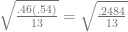

For the simple measure of more runs, the proportion was .31, meaning that the margin of error is 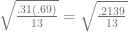

How Useful is the Pythagorean Expectation? May 18, 2010
Posted by tomflesher in Baseball.Tags: baseball-reference.com, one-game playoffs, Pythagorean expectation, wins above expectation
add a comment
The Pythagorean expectation is a method used to approximate how many wins a baseball team “should” have based on its offense (runs scored) and its defense (runs allowed). As the linked article points out, there are some problems with the formula. As far as I’m concerned, the most useful application of an expected win percentage is to compare teams that are otherwise similar. Let’s say, for example, that I have two teams that have identical records and I want to predict which team will win an upcoming series. In that case, an expected win percentage would be useful to indicate which team has more firepower over time.
What’s the perfect way to test this? One-game playoffs. Behind the cut, I have the results of some number-crunching I did to test whether the Pythagorean expectation generates useful results.
Quickie: Dallas Braden's Perfect Game May 11, 2010
Posted by tomflesher in Baseball.Tags: Baseball, Braden's perfect game, Buehrle's perfect game, Dallas Braden, Oakland As, probability, sabermetrics, Tampa Bay Rays
add a comment
Dallas Braden of the Oakland As pitched a perfect game Sunday, on Mother’s Day. Under the methods discussed last year after Buehrle’s perfect game, Braden – who’s been active for four seasons – has an OBP-against of .328. That means he has a probability for any given plate appearance of .672 of the batter not reaching base.
Since he sat down 27 batters consecutively, the probability of that event happening is (.672)27, or .0000218; equivalently, given his current stats, a bit over 2 in every 100,000 games that Braden pitches should be perfect games.
Over the same period (2007-2010), the American League OBP has hovered between .331 (this year) and .338 (2007). .336 was the mode (2008, 2009), so I’ll use it to estimate that the chance for a perfect game facing the league average team would be (.664)27, or .0000157, or equivalently about 1.5 out of every 100,000 games should be a perfect game.As you can see, it’s more likely for Braden than the average pitcher, but not by much.
Nice job, Dallas!
As a side note, the Tampa Bay Rays were the victim of BOTH perfect games. Their team OBP was .343 in 2009, with a probability not to get on base of .657, meaning that the probability of getting 27 batters seated consecutively is about 1.2 in 100,000. Since many other teams have lower team OBPs, it’s very surprising that the Rays were the victims of both games.

 The World's Worst Sports Blog
